
Chatbots are now a standard part of how people interact with businesses online. Our data shows that almost 1.5 million users had at least one chatbot conversation in the past year.
At the same time, the broader market is expanding rapidly as companies invest in automation and AI-powered support. Businesses are looking for ways to handle rising customer expectations, reduce support costs, and stay available around the clock.
A few numbers that set the stage:
- 60% of business owners believe AI chatbots can help improve customer experience
- 82% of respondents would talk to a chatbot if there was any waiting involved in speaking to a human representative
- 90% of customer queries are resolved in fewer than 11 messages
- The chatbot market is projected to reach $15.5 billion by 2028, up from $4.7 billion in 2020
To give you a complete picture, we combined insights from multiple industry studies with our own aggregated usage data. The result is a comprehensive overview of chatbot statistics covering adoption, performance, customer attitudes, ROI, and market growth.
Here are the chatbot statistics you should know about:
Chatbot adoption and market growth statistics
Chatbots are now mainstream across industries, with adoption accelerating as AI capabilities mature and customer expectations rise.
- Chatbot adoption across businesses grew roughly 4.7× between 2020 and 2025, showing rapid expansion in a short period.
- By 2025, the number of businesses using AI chatbots had increased by 34%, reflecting continued investment in automation.
- Roughly 60% of B2B companies and 42% of B2C companies use chatbot software, with B2B adoption currently higher.
- 69% of service professionals say their organization uses at least one form of AI, and 39% report using agentic AI specifically.
- The global conversational AI market was valued at $9.9 billion in 2023, signaling strong enterprise demand. Now, it’s projected to reach $15.5 billion by 2028, up from $4.7 billion in 2020, with an annual growth rate of about 23%.
Skyrocket your business with powerful AI agents
Chatbot user engagement
Customer behavior clearly favors speed and convenience, especially when human support involves delays.
- About 82% of respondents would talk to a chatbot if there was any waiting involved, highlighting low tolerance for queues.
- 53% find waiting extremely frustrating, and only 18% are willing to wait 15 minutes to speak to a live agent.
- 43% say a poor customer service experience prevents them from making a repeat purchase, linking support quality directly to revenue.
- About 90% of customer queries are resolved in fewer than 11 messages, with an average of 11 exchanges per thread.
- Our study found that almost 27% of shoppers use chatbots daily, while 34% do so a few times a week.
- 60% of people interact with support chatbots when prompted.
Read more: Check out the best customer engagement software available.
Chatbot expectations
When it comes to chatbots, customers also expect:
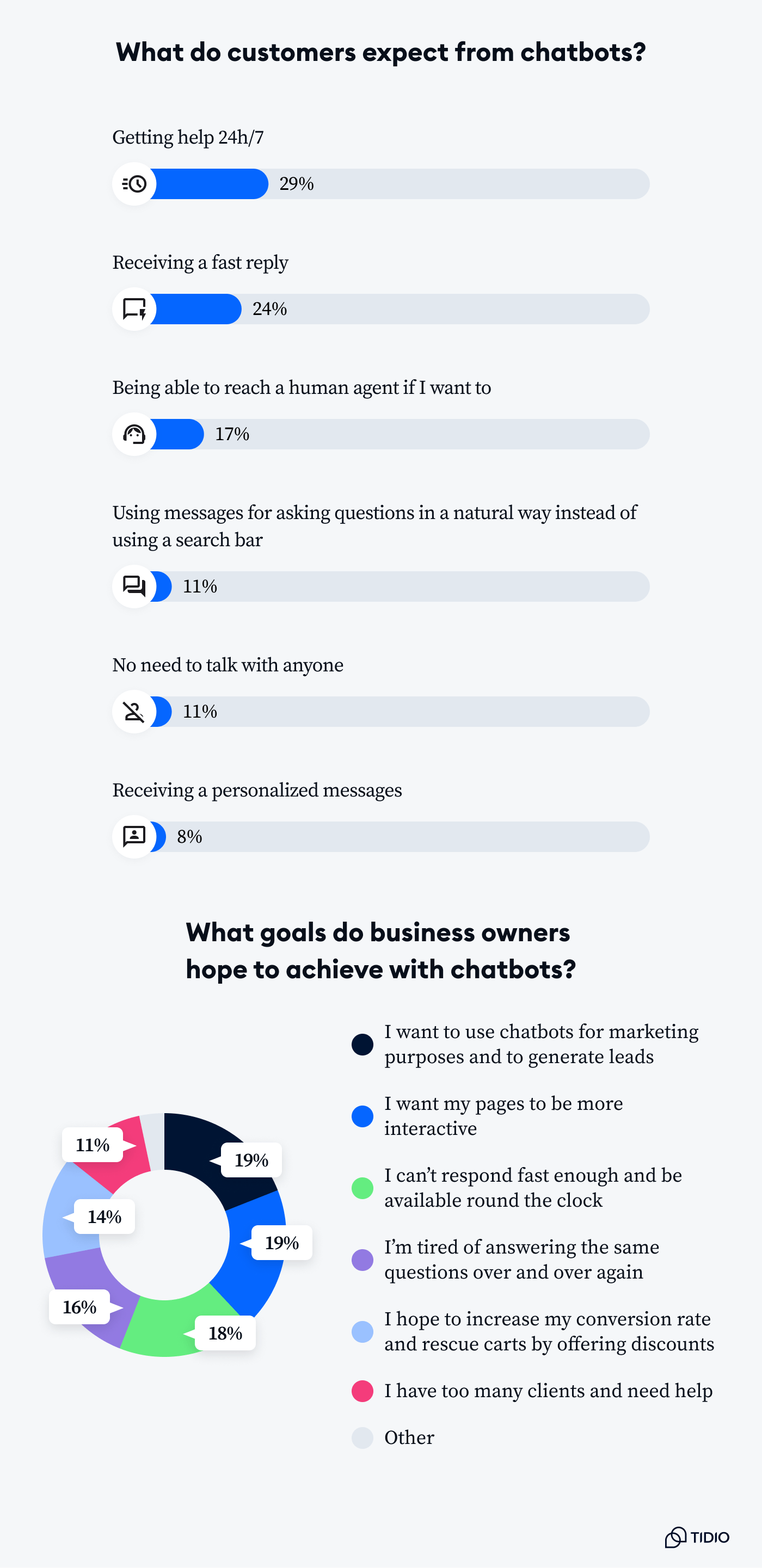
- Getting help 24/7 (29%)
- Receiving fast reply (24%)
- The ability to reach a human agent if they want to (17%)
About 11% would use them to ask questions instead of using search. Around 8% would prefer a personalized message, while 11% simply have no need to talk to anyone.
Customer satisfaction
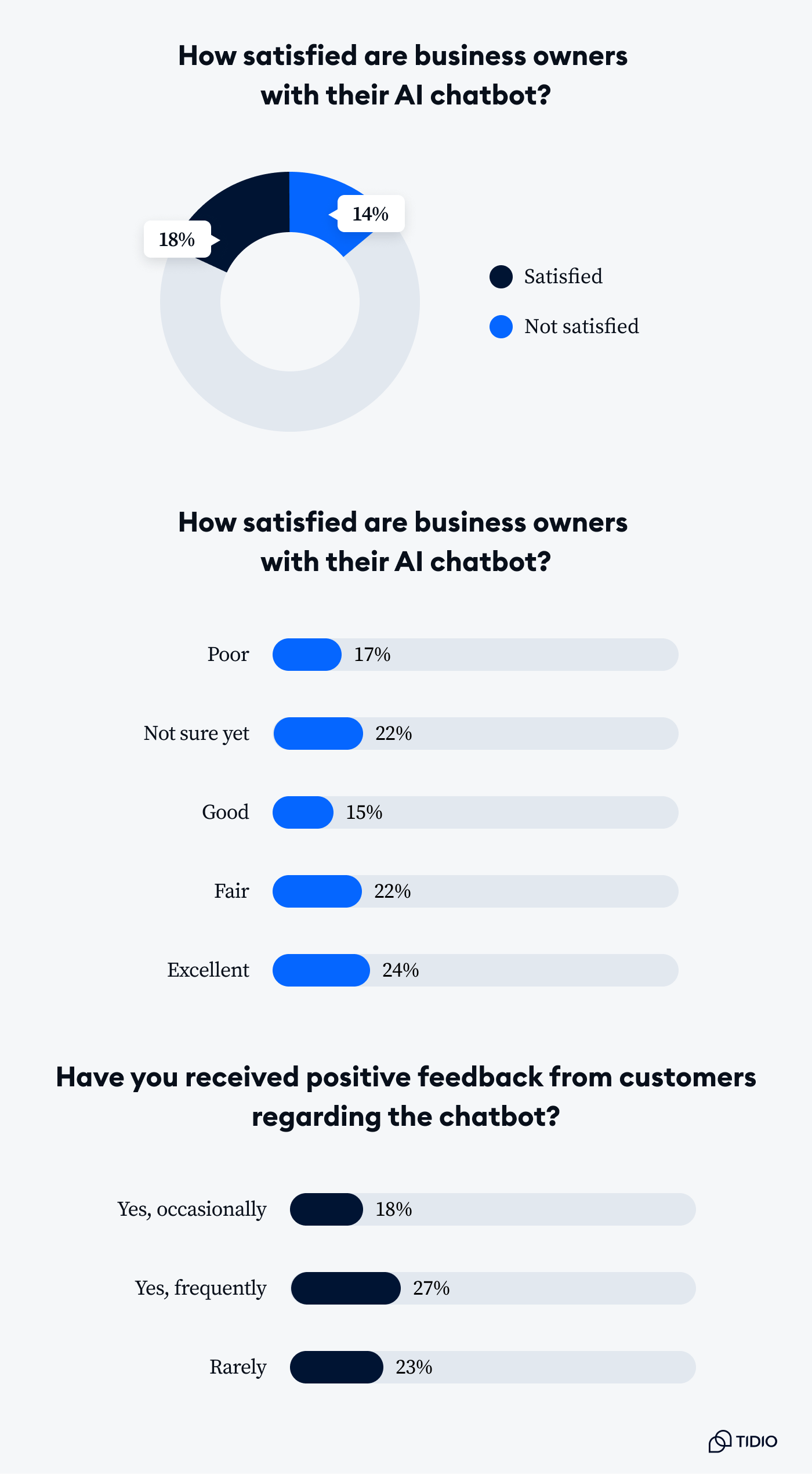
Our study shows that most businesses are very satisfied with how chatbots have improved their customer service and marketing operations. Here’s a more detailed breakdown:
In general, public perception regarding chatbots is overwhelmingly positive:
- More than 96% think businesses that use chatbots take good care of their customers.
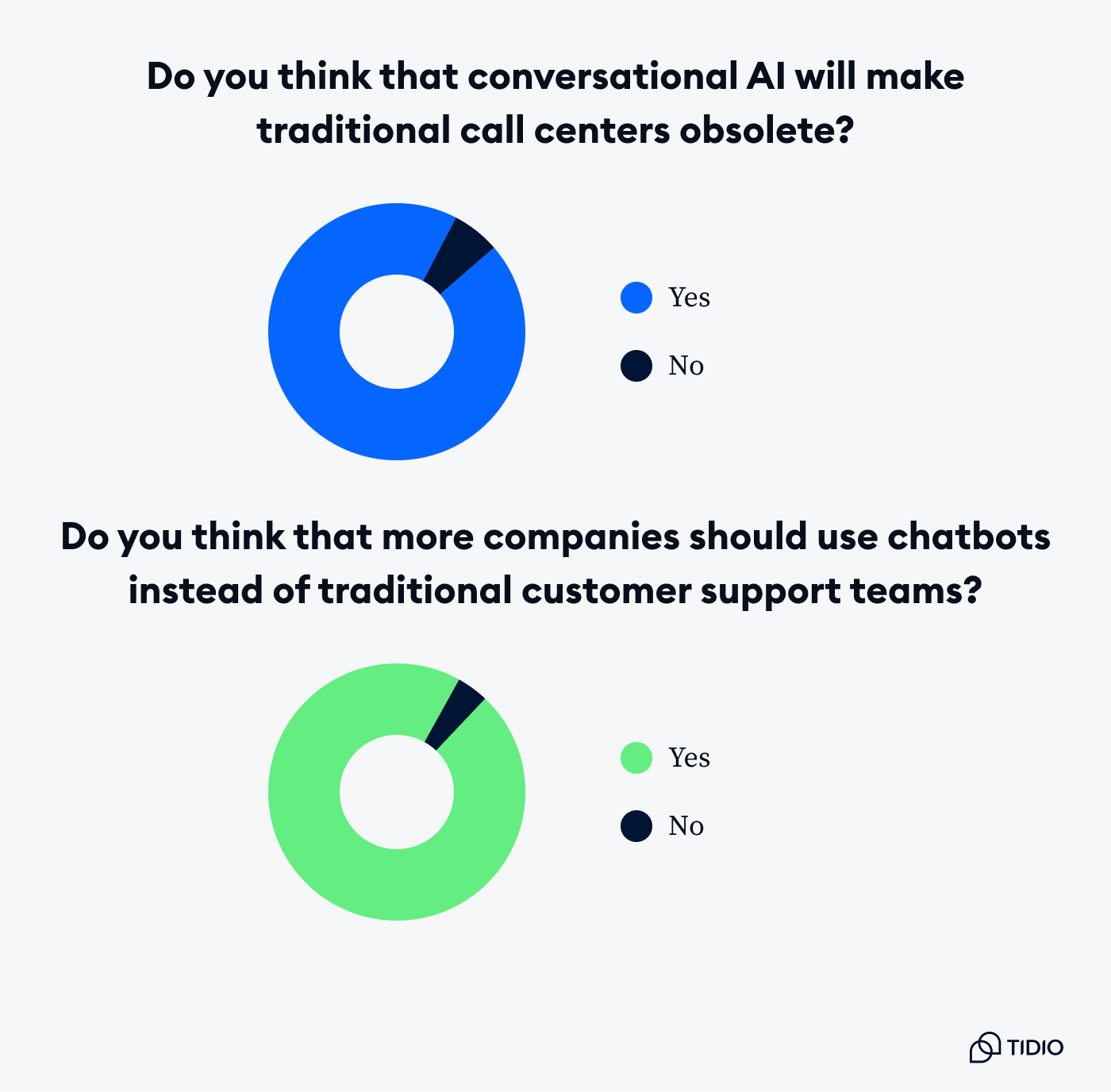
- 94% agree chatbots will make traditional call centers obsolete.
- Only 4% believe businesses should rely solely on human agents.
- Around 64% of people trust AI chatbots, and 60% say chatbots frequently influence their purchasing decisions.
Read more: Find out all about retail chatbots, including top use cases and benefits.
Business impact of chatbots
Chatbots help businesses forget about many customer support-related problems.
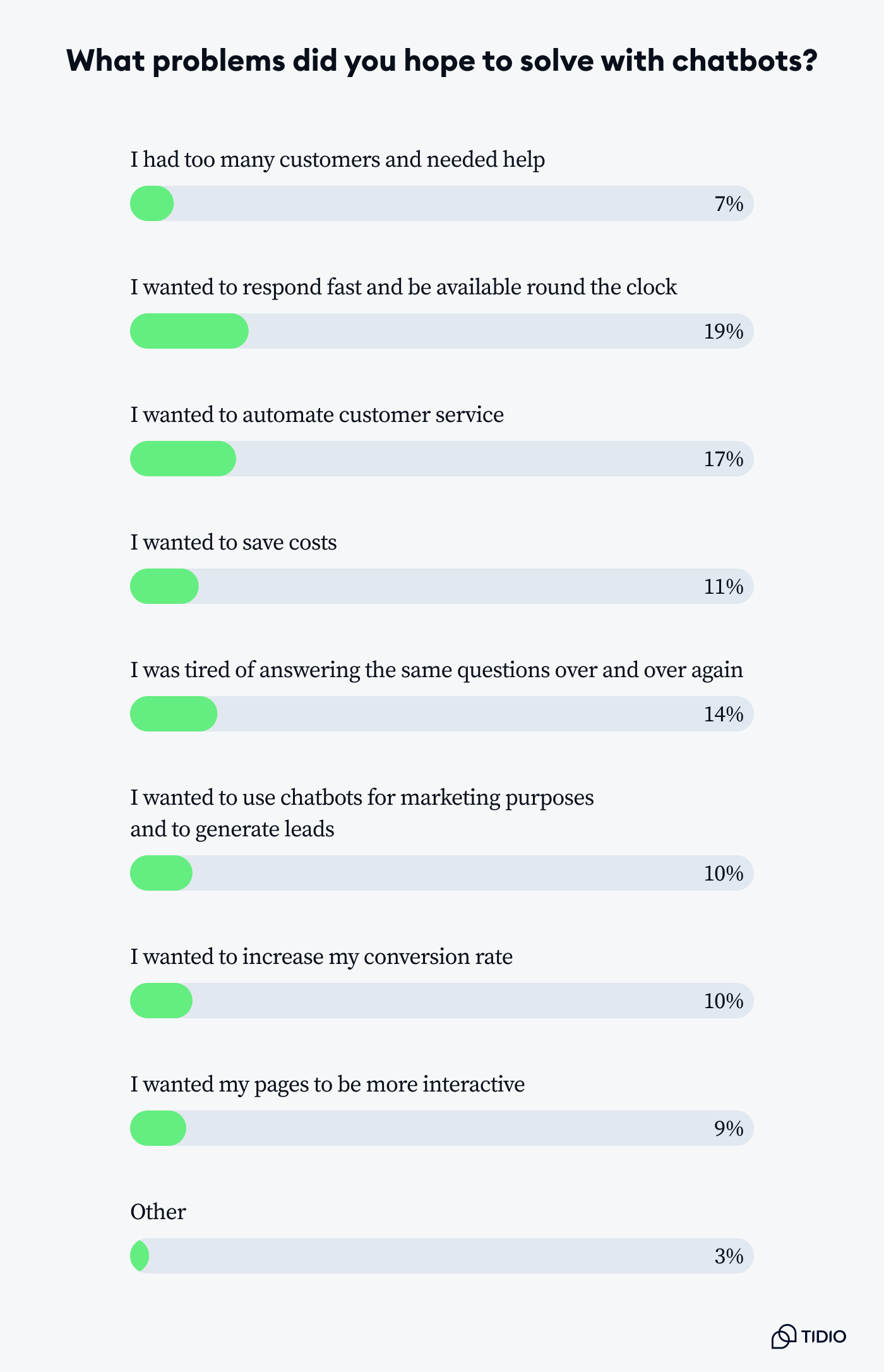
Our data indicates that they started using chatbots because:
- They wanted to be available round the clock (19%)
- To automate customer service (17%)
- Stop answering the same questions over and over again (14%)
- And save costs (11%)
Other reasons for implementing chatbots included:
- Marketing purposes and lead generation (10%)
- Increasing conversion rates (10%)
- And making pages more interactive (9%)
The great news is that 55% of businesses achieved exactly what they wanted with chatbots.
Read more: Here are easy ways to use chatbots for business.
Business confidence, concerns, and AI readiness
Most businesses see AI chatbots as a way to improve support quality, though concerns remain around security and implementation.
- About 60% of business owners believe AI chatbots can improve customer experience.
- Around 50% of people still have concerns about using AI, often related to costs, mistakes, or a lack of human qualities.
- 51% of service leaders say security concerns have delayed or limited AI initiatives.
- At the same time, 86% are willing to pay more for technology that secures data, showing that safe AI is becoming a buying requirement.
- 82% of service professionals say customer expectations are higher than they used to be, increasing pressure to automate.
AI knowledge integration and operational maturity
As chatbots become more advanced, businesses expect them to work with internal data and stay up to date.
- Almost 70% of businesses want to feed AI with internal knowledge and past support conversations to improve accuracy and context.
- About 60% prefer using information stored in Google Drive as a primary knowledge source.
- Around 17% update their internal knowledge at least once a day and expect their AI customer service solution to keep pace.
Read more: Find out key elements of a solid AI knowledge base and explore the best tools in this category.
Voice assistants and omnichannel AI adoption
Voice-based AI continues to grow alongside text-based chatbot usage.
- In 2024, over 8.4 million businesses were using voice assistance, with a 2.9% year-over-year growth rate.
- 85% of service professionals using voice AI say transitions to human representatives are seamless, which is critical for maintaining experience quality.
Customer savings, ROI, and perception
Chatbots deliver measurable financial impact. Businesses report about $20 million in cost savings, and support teams can reduce customer service costs by up to 30% through automation.
Additional ROI and revenue data:
- The global chatbot market is valued at $7.76 billion, reflecting strong commercial adoption.
- The average chatbot ROI is about 1,275%, based on support cost savings alone.
- Online stores see a median order value increase of 20% within the first 7 days of implementing chatbots.
Chatbot conversion and engagement rates
While conversion claims vary by industry, chatbots clearly influence purchasing behavior. In some sectors, sales increases can reach up to 70%, although results depend heavily on implementation and context.
- Around 6% of users respond to CSAT score requests, which reflects feedback engagement rates.
- Upselling and discount chatbot campaigns typically generate higher interaction levels than standard service flows.
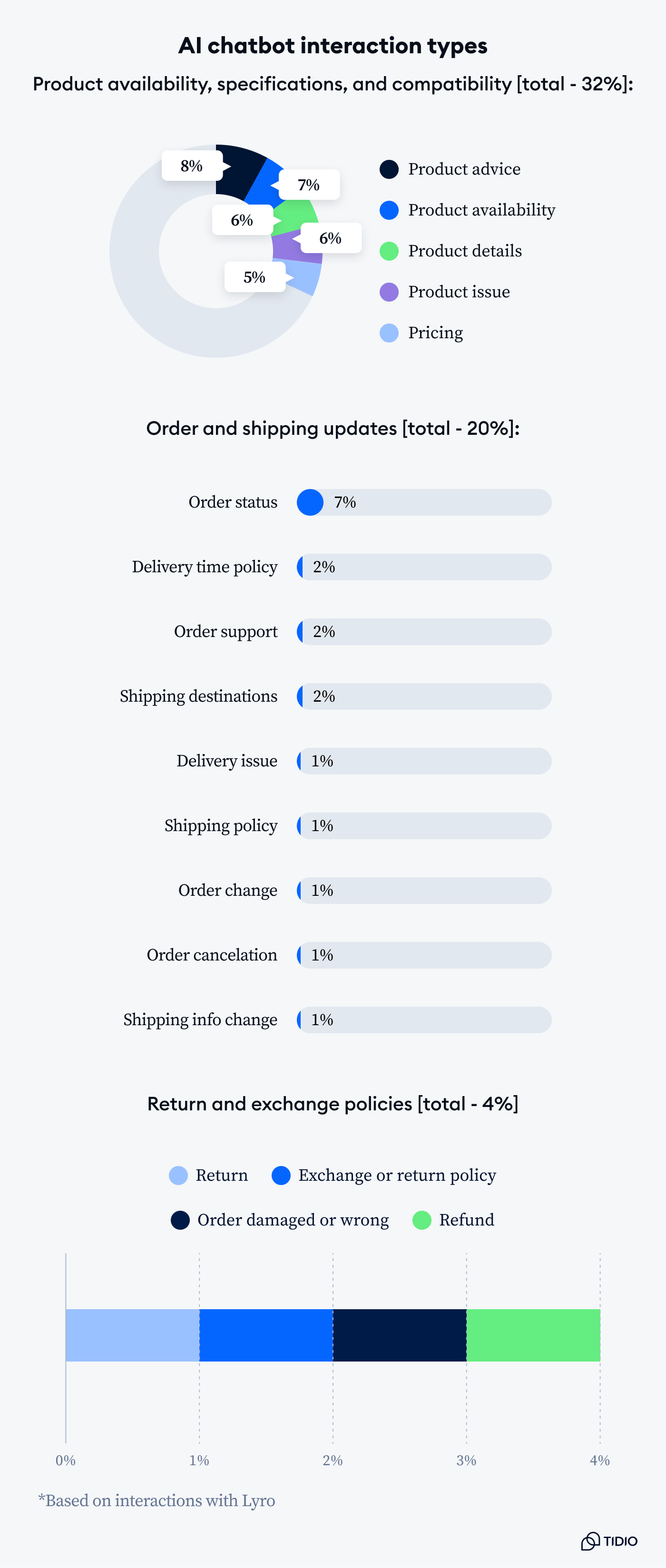
Here’s a breakdown of AI chatbot stats related to customer interactions:
Customer trust and perception of chatbots
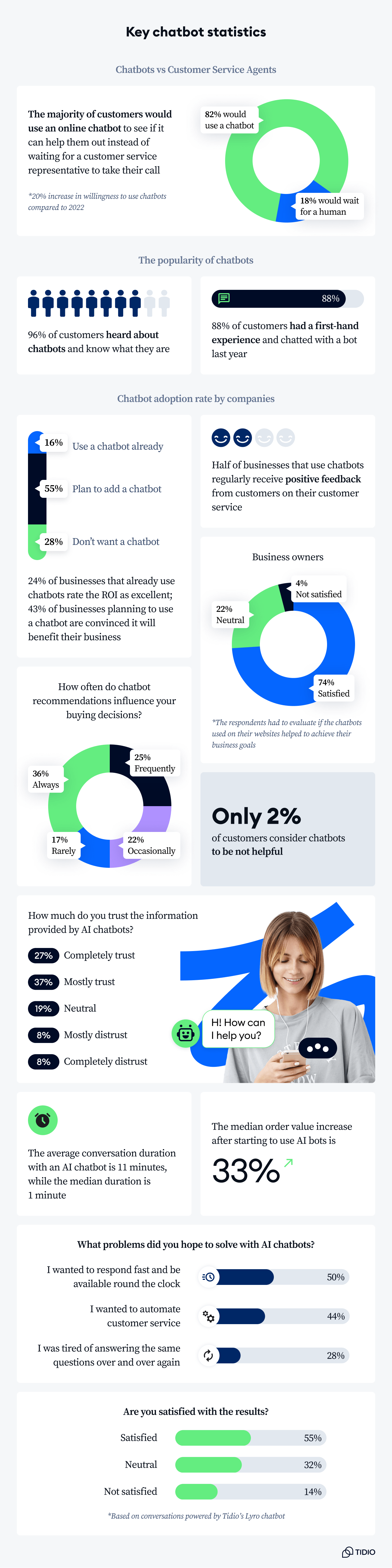
An overwhelming majority of customers (82%) say they would use a chatbot, while 18% report they’d wait for a human.
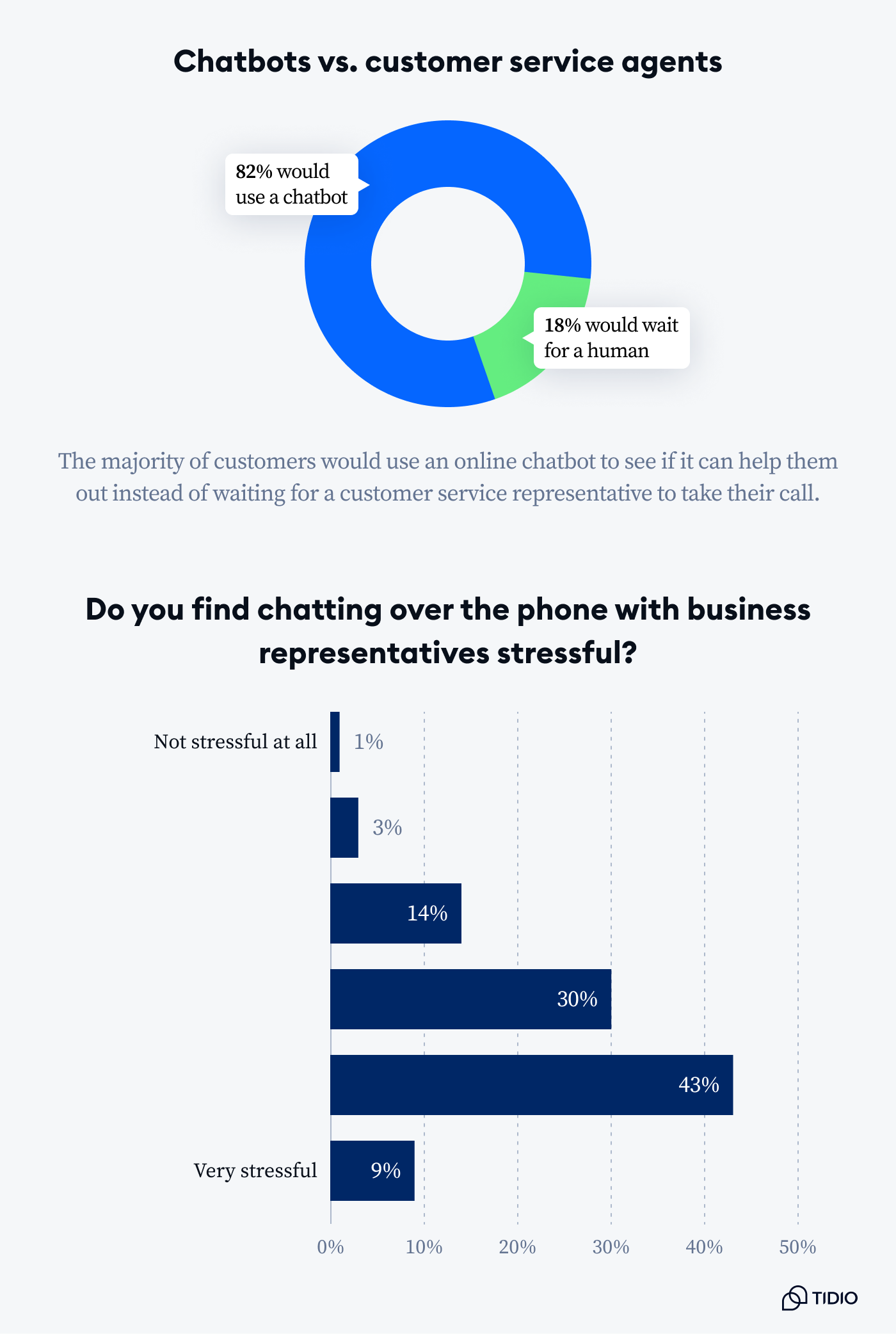
Many customers are pretty stressed out when it comes to calling customer support representatives. Hence, many problems remain unsolved, and customers stay dissatisfied.
Also, as many as 96% of consumers think that companies should use chatbots instead of traditional support teams.
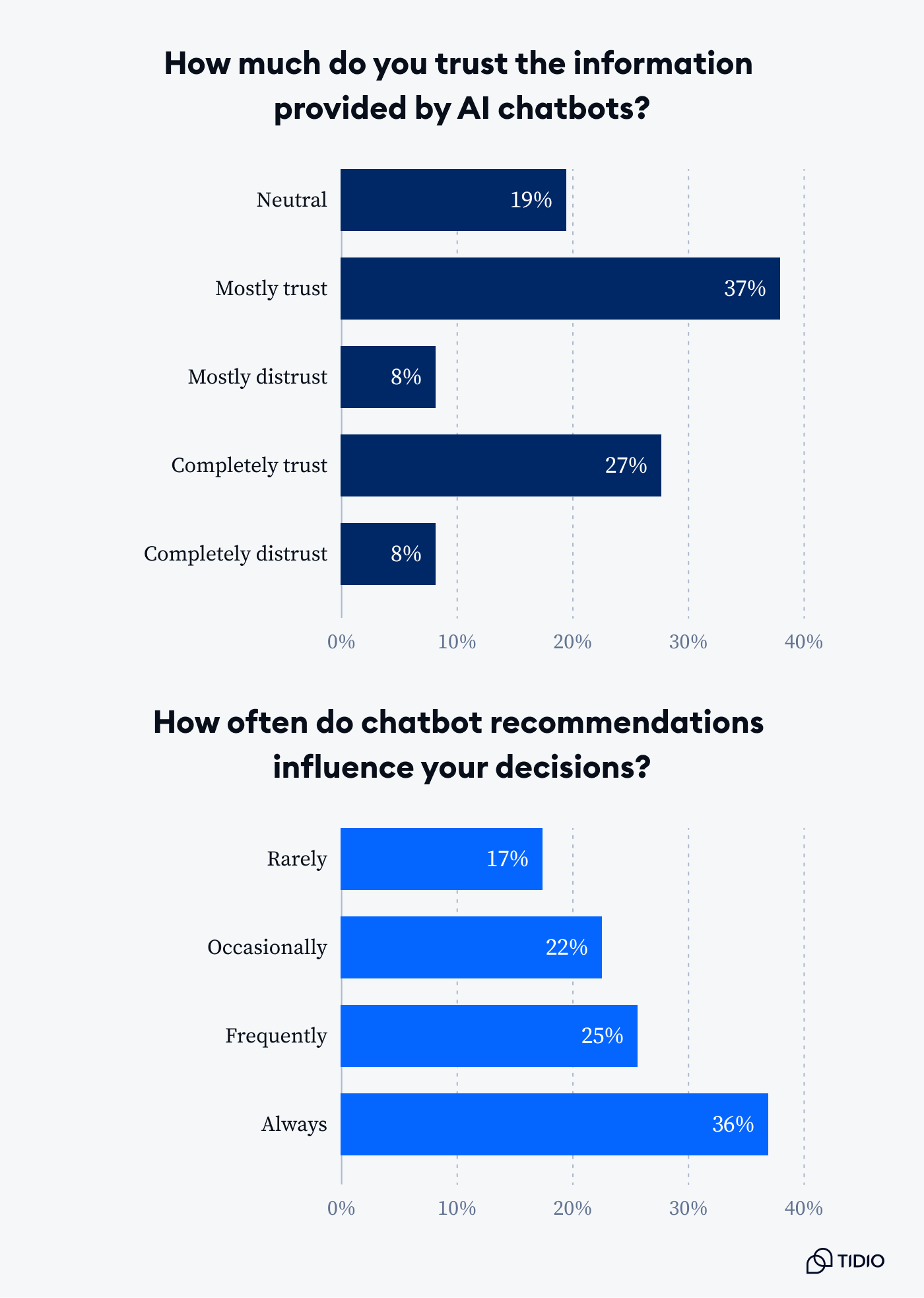
Trust levels are largely positive, with 64% of respondents saying they mostly or completely trust chatbot-provided information. Also, around 60% of consumers say chatbots frequently influence their purchasing decisions.
Breakdown of responses:
- 27% completely trust chatbot information
- 37% mostly trust chatbot responses
- 19% feel neutral about chatbot reliability
- 8% mostly distrust chatbot information
- 8% completely distrust chatbot responses
Generation Z and chatbot trends
Gen Z is often described as highly enthusiastic about new technology, but their attitude toward chatbots is more nuanced:
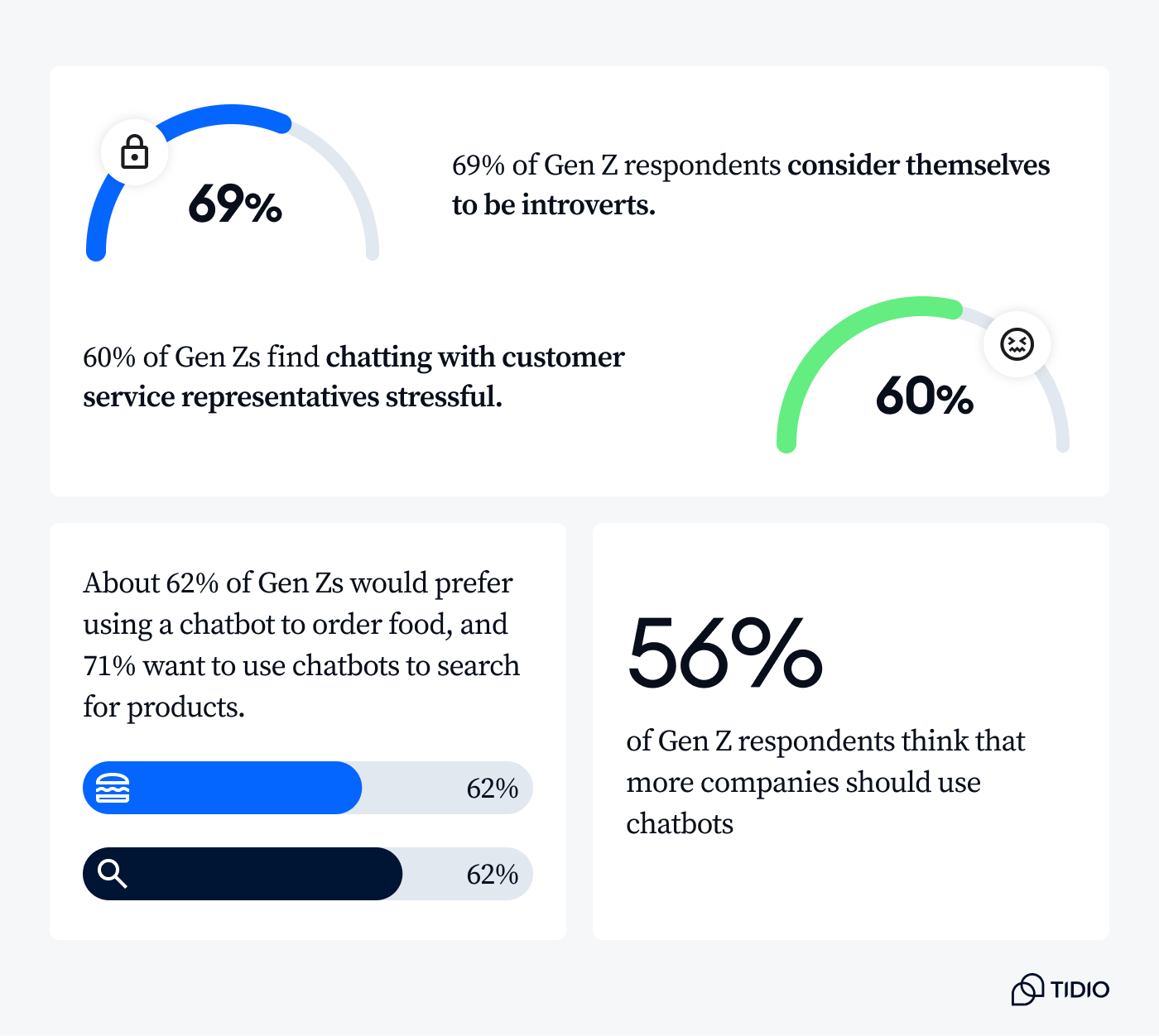
- 60% of Gen Zs find chatting with customer service reps stressful.
- 56% believe more companies should use chatbots.
- Around 20% prefer starting customer service with chatbots, compared to only 4% of boomers.
- However, only 44% of Gen Zs believe chatbots will make traditional call centers obsolete, showing they still expect human backup.
Read more: Check out key customer service trends you should know about.
AI agents and large language model adoption
AI-powered chatbots are rapidly evolving into AI agents capable of handling more complex, context-aware interactions.
- ChatGPT surpassed 800 million weekly active users in late 2025, up from 300 million just a year earlier, signaling massive adoption of LLM-driven systems.
- Advanced LLMs such as Google Gemini, Anthropic Claude Opus/Claude 5, and Meta Llama 4 are gaining enterprise adoption. These models are being integrated across ecommerce, healthcare, and education.
- Chatbot adoption across businesses grew roughly 4.7× between 2020 and 2025, even before large-language-model-driven agents became widespread.
AI-driven changes in search and online behavior
AI tools are becoming a measurable part of everyday digital behavior. In the US, AI tools increased their share of desktop events from 0.42% in December 2024 to 0.77% in December 2025.
Regional and behavioral shifts include:
- In Europe, AI desktop share rose from 0.44% to 0.89% over the same period.
- By Q4 2025, ChatGPT became the 7th most visited destination after search in both the US and Europe.
- Search queries are shifting toward longer phrasing, with growth in the 6–9 word range and 15+ word range, reflecting more complex user intent.
AI agents in ecommerce
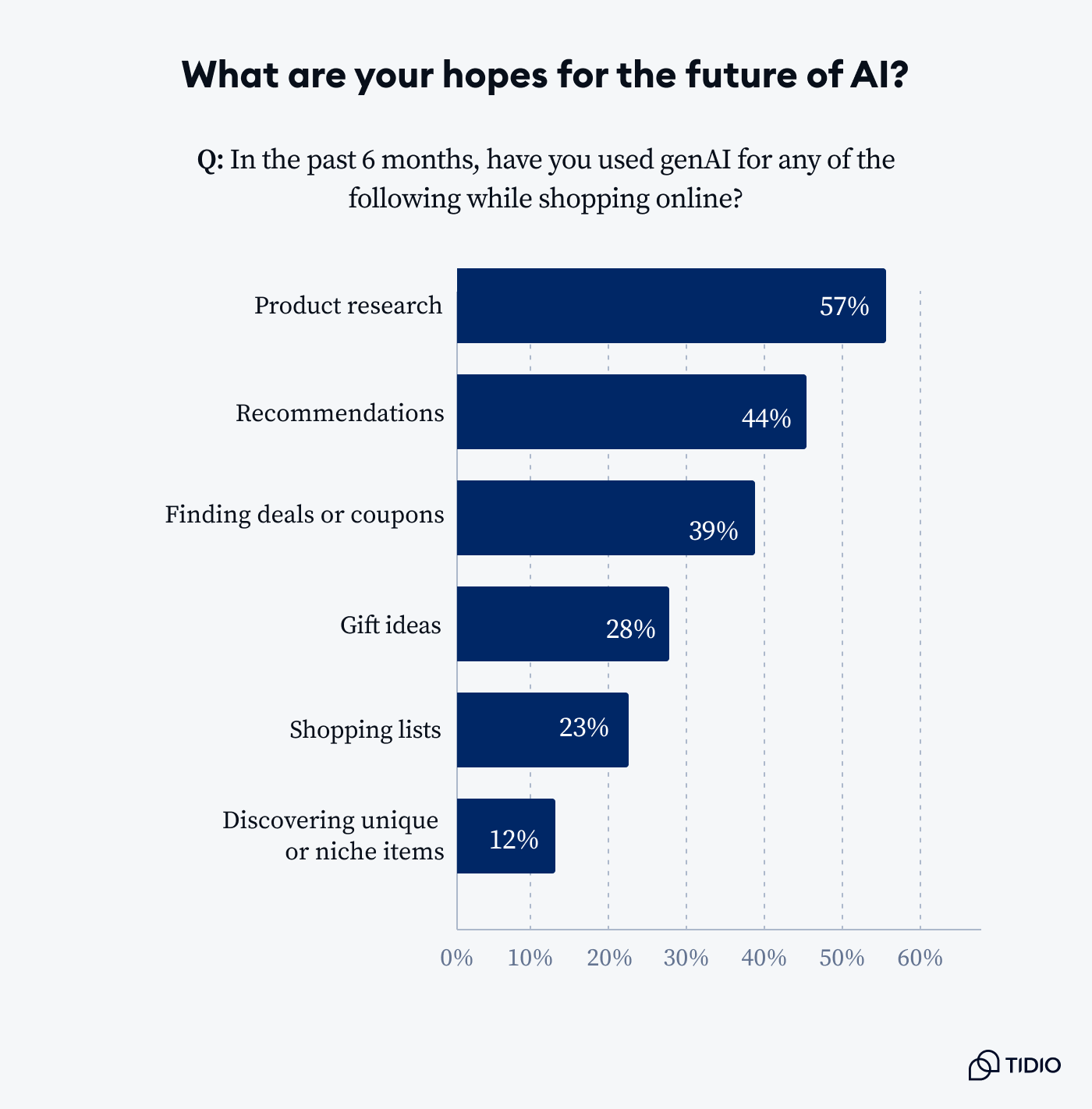
AI is expanding beyond support into purchase guidance and product discovery. In July 2025, 12.3% of US online shoppers reported using generative AI tools in the past six months to assist with shopping-related activities.
Common AI-assisted shopping use cases include:
- Product research (57.3%)
- Recommendations (44.6%)
- Finding deals or coupons (39.5%)
- Generating gift ideas (28.4%)
- Building shopping lists (23.7%)
- Discovering niche products (12.3%)
Read more: Explore the best AI agents for ecommerce on the web, along with their pros, cons, and pricing.
Investment trends and future service automation
Businesses are preparing for deeper AI integration across service operations. Service professionals expect AI to resolve 50% of service cases by 2027, up from 30% in 2025.
- 79% of service leaders say investment in AI agents is essential to meet business demands.
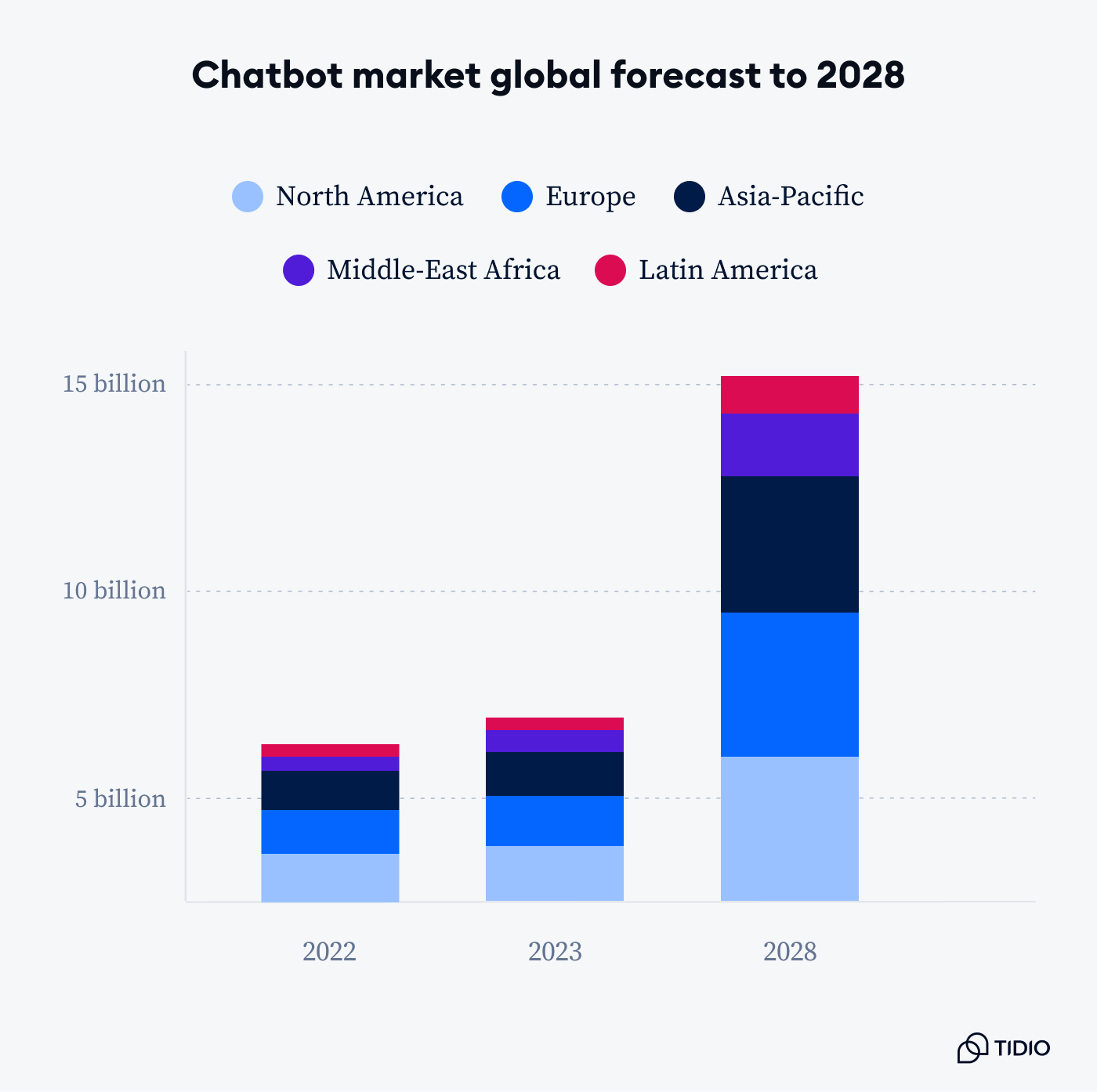
- The chatbot market is projected to reach $15.5 billion by 2028, up from $4.7 billion in 2020.
- Annual growth rate remains strong at about 23%.
Chatbot statistics: bonus points
It’s clear that chatbots are heavily influencing practically every sphere of life and business. Here is some data proving the impact of chatbots on finance, healthcare, HR, and marketing.
Chatbot marketing trends
- Marketing is the third most common application for chatbots, holding 17% of the total market share.
- Around 80% of marketing and sales leaders have implemented or plan to implement AI bots into customer experience.
- As many as 55% of companies using chatbots for marketing experience a rise in high-quality leads.
Read more: Explore the topic of chatbot marketing, including the best software and use cases.
HR chatbot statistics
- Career websites get 95% more leads by engaging with job seekers through chatbots.
- For many HR departments, bots help to free up more than 12,000 work hours annually.
- The global HR chatbot market is expected to reach a whopping $1.2 billion by 2027.
Chatbots in finance
- The size of the chatbot market in BFSI (banking, financial services, and insurance) is estimated to reach nearly $7 billion by 2030.
- The use of financial services chatbots can help customers save around 4 minutes per inquiry, which will directly add value to customer satisfaction.
- As many as 43% of banking customers prefer to resolve issues through a chatbot.
- Around 80% of financial institutions see chatbots as a great opportunity to enhance their client service.
Chatbots in healthcare
- Around 83% of executives agree science tech capabilities could help address global health-related challenges
- Currently, around 63% of health organizations are incorporating AI.
- 70% of healthcare workers’ tasks could be reinvented by AI or automation technologies
- Medical professionals think chatbots could be useful for booking medical appointments. (78%), finding healthcare facilities (76%), and offering information about medications (71%).
AI chatbot statistics: conclusion
Chatbot adoption continues to accelerate across industries, supported by strong ROI, growing user engagement, and increasing trust in AI-powered support.
Key takeaways from the data:
- The chatbot market is projected to reach $15.5 billion by 2028, growing at about 23% annually
- Businesses report up to 30% cost savings in customer support and an average ROI of 1,275%
- 90% of customer queries are resolved in fewer than 11 messages
- 96% of consumers believe companies using chatbots take good care of their customers
- Only 4% think businesses should rely solely on human agents
According to data, chatbots are widely adopted. On top of that, they’re also financially impactful, and increasingly trusted by customers. As AI capabilities expand, chatbots continue evolving into intelligent agents that guide users through complete service journeys.
Maximize sales and revenue with intelligent AI agents
FAQ
Tidio is a customer service platform that combines live chat, chatbots, and AI to help businesses support and engage their customers in real time.
Yes. Tidio uses AI across its platform. Its Lyro AI Agent can be used to power smarter responses, automate support, and help teams deliver faster, more accurate customer service.
Yes. Tidio offers customizable chatbot flows and the Lyro AI Agent that can automate conversations, answer common questions, generate leads, and support website visitors 24/7 without human intervention.